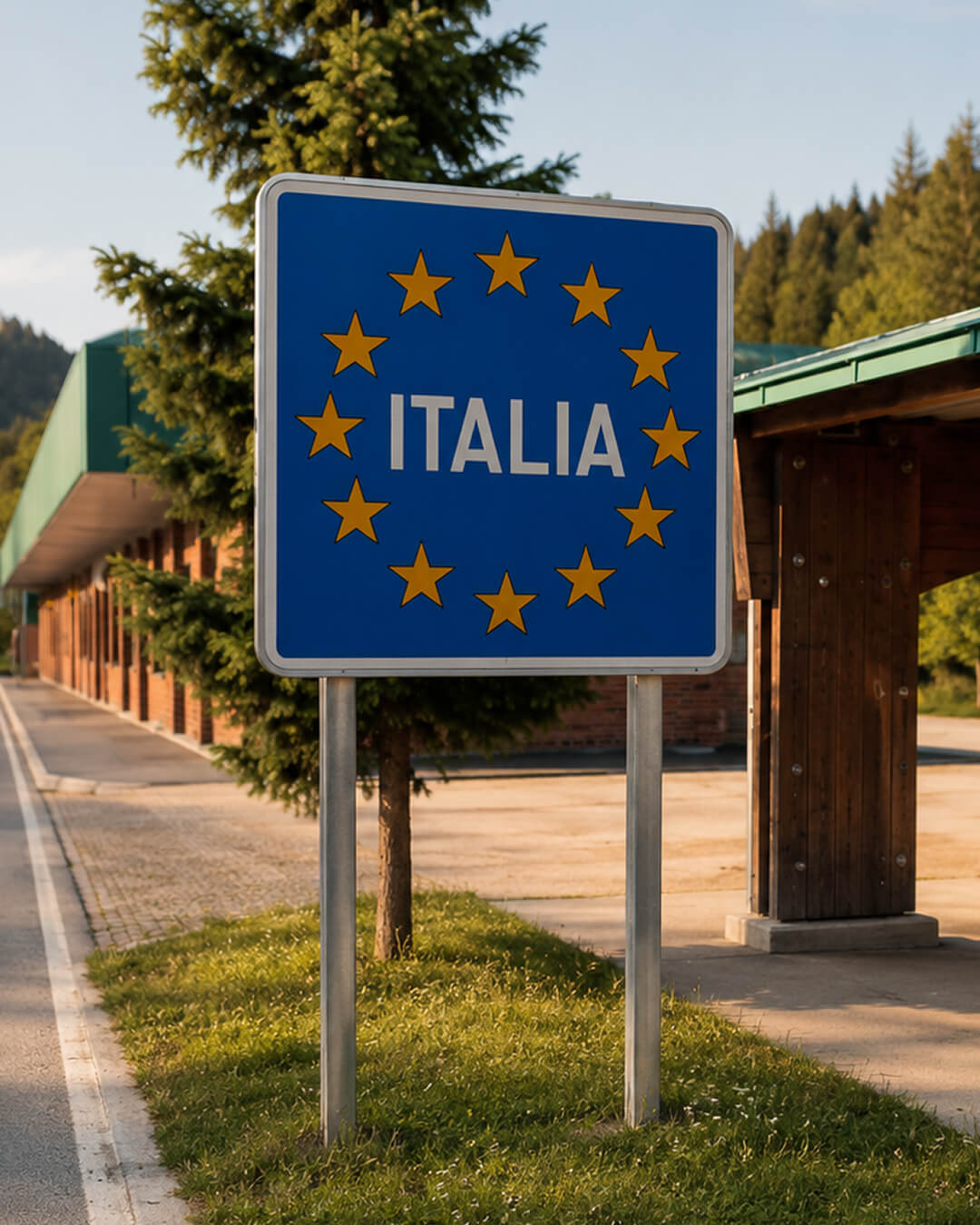
Entering Italy in 2026: Visas, ETIAS and the Biometric Border
Three separate sets of rules apply, and almost all the confusion online comes from treating them as one
There is not one set of rules for entering Italy but three, and they apply to different people. Almost all the confusion online comes from adding them together.
Worth separating out, because which of the three you fall into determines everything: whether you apply in advance, what it costs, and what happens at passport control.
Three Regimes, Not One
If your country travels to the EU without a visa (the United Kingdom, the United States, Canada, Australia and some sixty others), what awaits you is ETIAS. It is not a visa but an online authorisation on the model of the American ESTA. The essential point: it is not running yet, and that is dealt with below.
If your country needs a visa (Russia among them), the rules are the familiar ones: a Schengen visa, an application to a consulate, documents, a consular fee. A good deal has changed here in the past year, though not the thing people assume.
And a third that applies to every non-EU national regardless of the first two: the biometric entry and exit system. It is already running, and it has replaced the stamp in your passport.
Each in turn.
ETIAS: The System That Is Not There Yet
Here is the part most websites have not caught up with.
Until recently the official EU page promised that ETIAS would start operating in the last quarter of 2026. In July 2026 that line disappeared from the page. It now says only that the system is not in operation and no applications are being collected, and that the specific date will be announced several months before launch.
The reason is known. According to the Financial Times, eu-LISA, the agency building the system, has acknowledged that a launch by the end of this year is no longer feasible; one person briefed on the discussions called the prospect illusory. What is holding ETIAS up is not ETIAS but the entry and exit system that precedes it, whose rollout has gone badly. The eu-LISA management board discussed the matter on 17 June and is expected to meet again in September to set a revised timeline. The European Commission has issued no formal statement of postponement, but it is the Commission that will name the date, and only after testing has been completed successfully.
The realistic expectation today is 2027.
It is worth remembering that this is not the first postponement. ETIAS has been in development since 2016; the launch was set for 2021, then November 2023, then 2024, then the end of 2026. The present slip is the fourth or fifth depending on how you count.
Who does not need ETIAS at all: citizens of EU and European Economic Area states, Swiss nationals, holders of long-term residence in Schengen countries, and nationals of Andorra, San Marino, Monaco and the Holy See. Dual nationals need only enter on the European passport.
And one point worth understanding in advance: ETIAS is not a visa and not a guarantee of entry. It is a pre-screening, and the decision at the border is still the officer's. The twenty euros put it in the same family as the American ESTA and the British ETA, on which it is modelled.
What is already settled about ETIAS and will not change. The fee is €20. Applicants under eighteen and over seventy are exempt from the fee, though they still have to apply. The authorisation lasts three years or until the passport expires, whichever comes first. It covers thirty European countries. After launch there is a transitional period of at least six months during which travelling without one will not be grounds for refusal, provided the other entry conditions are met.
What to do now if you hold a visa-exempt passport: nothing. There is no portal, no applications are being taken, and any website offering to arrange ETIAS today is arranging something else.
The Schengen Visa, Briefly
The second category, and the one where public perception diverges from the figures most sharply.
On European Commission data for 2025 the refusal rate for Russian applicants was 6.3 per cent, against a global average of 14.6. They are refused at less than half the world rate, and the figure has fallen three years running. Italy sits among the most permissive consulates in that picture.
What did change is something else. Since November 2025 multiple-entry visas have effectively stopped for Russian nationals applying inside the country: single entry is the default, tied to a specific trip. Refusals became rarer, but an application is now needed before every departure.
That is a large subject in its own right, with figures, exceptions and the practice of applying, and it is covered separately in the Schengen visa: what the statistics show.
EES: The Part That Is Already Running
The third point applies to everyone, and it is the only one of the three you will certainly encounter.
The entry and exit system has operated at the EU's external borders since October 2025, with the transition completed in the spring of 2026. Passports are no longer stamped. On a first crossing your fingerprints and facial image are taken; after that checks run automatically, and the data is held for three years. Children under twelve are not fingerprinted. Neither a visa nor a visa-exempt passport excuses anyone from the process.
The rollout has been difficult, and not in the abstract: it is precisely those problems that pushed ETIAS back. The Commissioner for Internal Affairs has publicly linked the delays to insufficient staffing and unready infrastructure in the member states themselves. The practical conclusion for a traveller is simple: on a first entry with a new passport, allow more time at the border than you are used to.
How Long You May Stay, and Why a Machine Now Counts It
The short-stay rule is the same for visa-exempt travellers and for most visa holders: ninety days within any hundred and eighty. That in itself is not new.
What is new is who does the counting. The total used to be reconstructed from passport stamps: by hand, by eye, with errors in both directions. A smudged stamp or a page the officer did not turn could go unnoticed for years.
Entries and exits are now written to a shared database, and the remaining days are computed automatically at every crossing. An overstay is no longer a question of one border guard's attentiveness. For the overwhelming majority of travellers this changes nothing; for anyone who spent years in the grey zone between tourism and living in Europe, it changes everything.
What to Do, by Passport
A visa-exempt passport. Nothing. Fly as you always have. Watch for the ETIAS date, expect 2027, and pay nobody for it now.
A passport that needs a visa. Assume a single-entry visa tied to specific dates. Planning starts with the booking and the itinerary rather than ending with them. Apply to the consulate of the country where you will spend the most time, or, where equal, the one you enter first. Do not cancel bookings after applying. Check the insurance separately; it is what catches people most often.
Everyone. A first entry on a new passport means a fresh biometric registration. Do not cut a connection fine.
Rules here change faster than articles are published, so we keep the current position in Pulse.
Rome and Venice are waiting for the formalities to be over. Open City map of Rome or the City map of Venice.