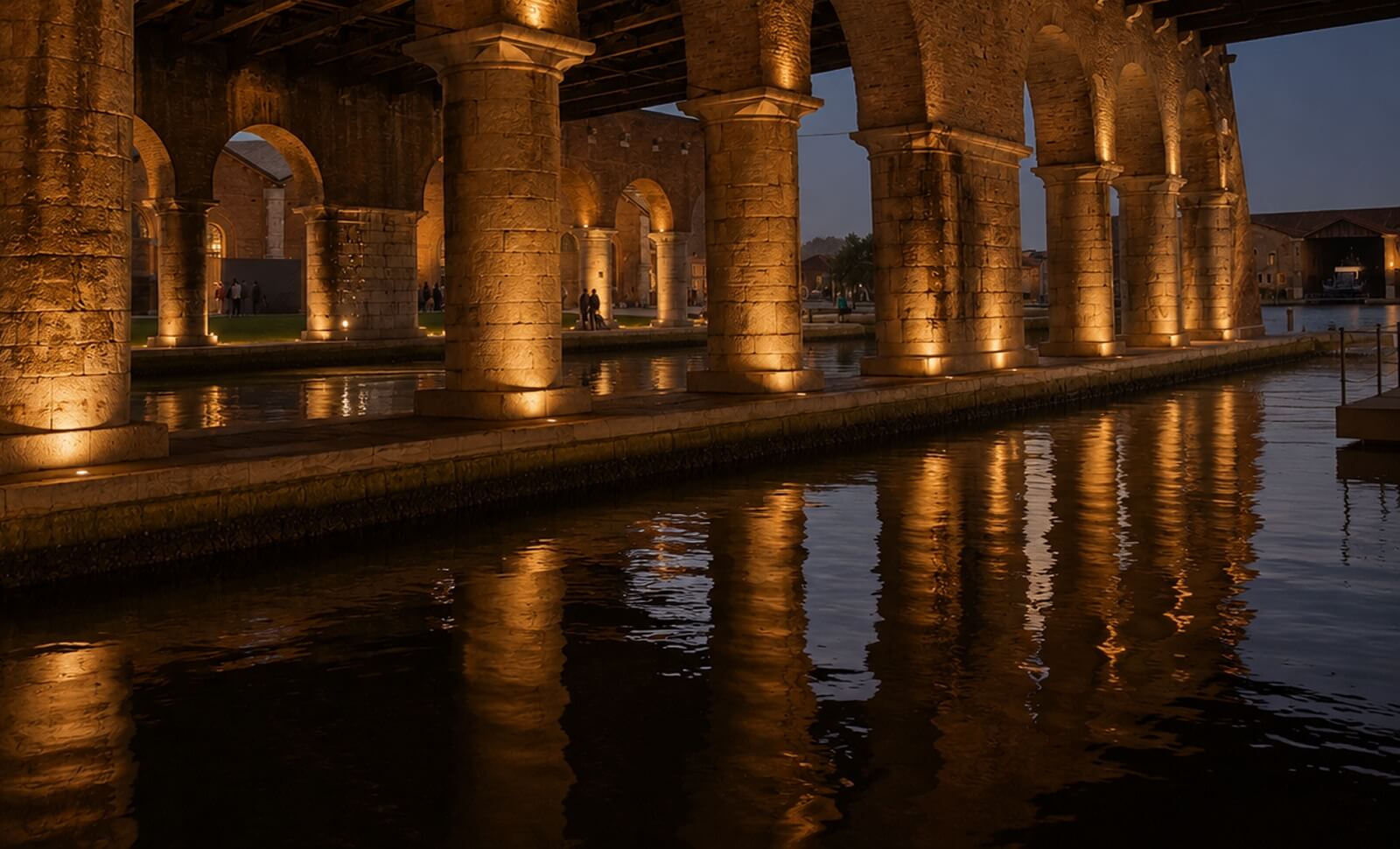
Venice charges for entry. How the city on piles turned fragility into a ticket
The MOSE barriers, the ban on cruise ships, and the world's first paid entry to a city. How Venice fights to survive — and what of it concerns you.
Venice has a paradox it has brought to perfection: it is a city that is physically sinking under water — and yet charges for entry. Not a metaphor. Since 2024 Venice has become the first city in the world to introduce a ticket for the right to enter its historic centre. Let us look at how this came about, whether it works, and what it means for you.
A city that truly is sinking
Venice stands on piles in the lagoon, and every autumn and winter it is flooded by the acqua alta — the high water. To save itself, the city built MOSE — a system of movable underwater barriers at the mouths of the lagoon. Completed by 2020, it rises when the water goes above a critical mark and cuts the Adriatic off from the city. MOSE has more than once saved San Marco from flooding — but the upkeep costs mad money, and the sea level keeps rising.
Thirty million guests and fifty thousand residents
The second threat is not water but people. Before the pandemic about 30 million tourists a year came to Venice, and most were day-trippers: arrived for a couple of hours, photographed the Rialto, left, giving the city almost nothing but rubbish and a crowd. Meanwhile the permanent population of Venice fell to about 50,000 — there are already more tourist beds in the city than local residents. The city is slowly turning into its own stage set.
Venice began to charge for entry
The city's answer is the Contributo di Accesso, an entry fee for day-trippers. How it works in 2026:
- €5 if paid at least 4 days ahead; €10 at the last moment. Per person, per day.
- It applies for 60 days — from 3 April to 26 July 2026, mainly Friday to Sunday and holidays, and only from 8:30 to 16:00. Outside these hours entry is free.
- Payment online at cda.ve.it, with a QR code in hand. It is checked at seven entry points, including Santa Lucia station. The fine for a breach is €50 to €300.
- Exempt: children under 14, residents of the region, students, those working in the city and — above all — those who stay overnight in Venice (though you must still register).
Does it work
It is arguable. In 2025 the fee brought the city more than €5 million — but it barely thinned the crowds: on average about 13,000 people paid a day, and on a peak Saturday nearly 25,000, more than half of Venice's whole population. Critics call the measure symbolic. Alongside it the city has done harder things too: it has banned cruise ships from entering the lagoon, limited tour groups to 25 people, and forbidden guides' loudspeakers.
What it means for you
The practical conclusion is simple. Check whether your day falls on a paid date — if so, register ahead on cda.ve.it and pay €5, not €10. Better still, play the system as it was meant to be played: stay the night. Those who stay overnight pay no fee, and Venice in the evening without the daytime crowds is the city that was worth coming for. To arrive after 16:00, stay the night, meet the dawn by the water before the first groups — Venice quite literally rewards those who give it more than a couple of hours.