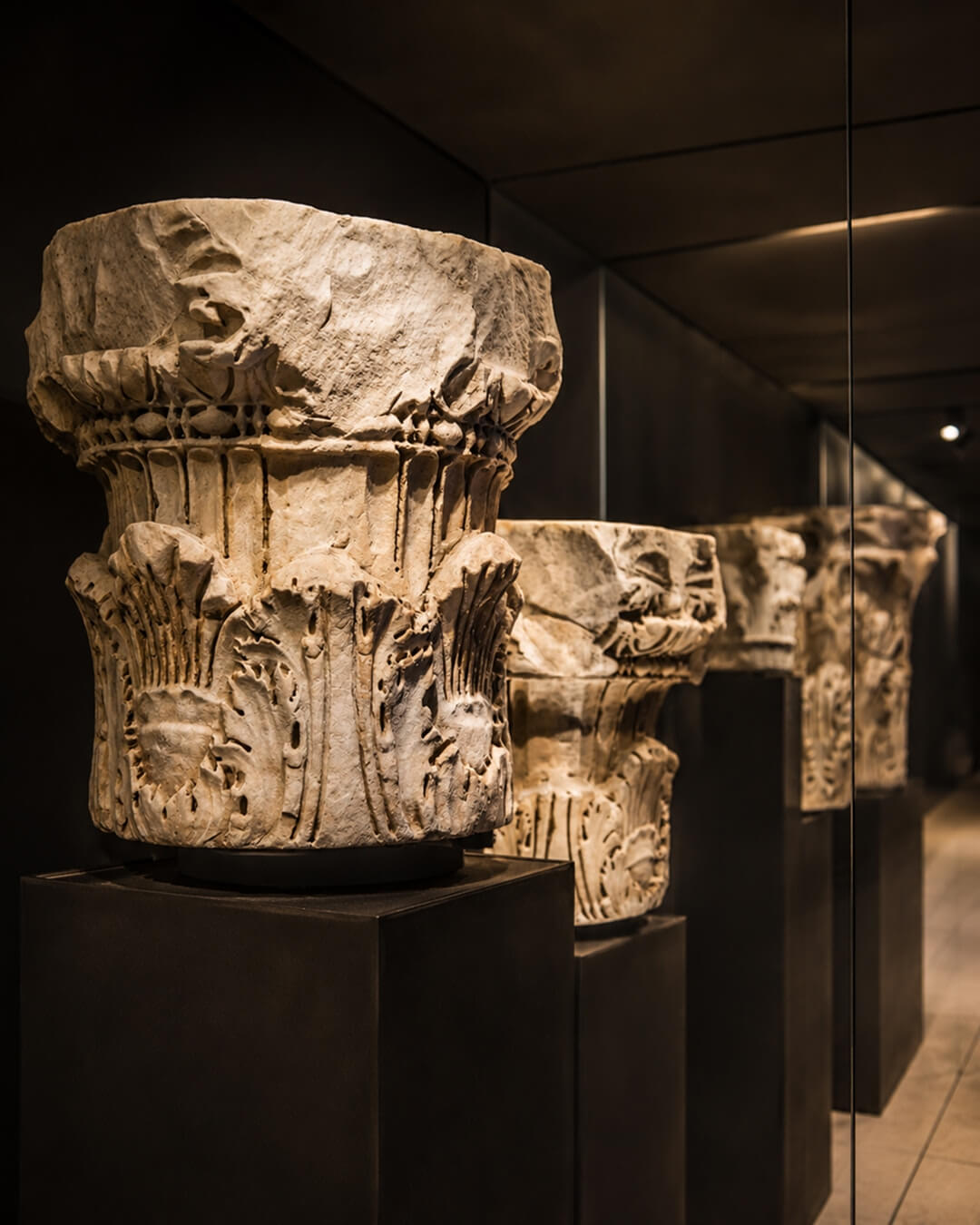
The Metro That Became a Museum: Line C Beneath the Forum
Two stations opened in December 2025 show Roman baths and a second-century barracks, and getting in costs the price of a metro ticket
Rome spent eighteen years building a third metro line and dug more out from under itself than most cities find in a century. The stretch from San Giovanni to the Colosseum, three and a half kilometres of it, was excavated from 2013 and opened on 16 December 2025.
What is interesting is not what they found. Things are always found under Rome. What is interesting is what they did with it.
Baths Under the Via dei Fori Imperiali
The Colosseo/Fori Imperiali station sits between the Colosseum and the Basilica of Maxentius. Four underground levels, up to fifty metres wide, thirty-two metres deep. The excavation cut through the Clivo di Acilio and the Clivo di Venere Felice, two ancient inclines previously known mostly from texts.
Out of the ground came Roman baths of the imperial period, with rooms that resolve into the recognisable sequence of a bathing circuit. Alongside them lay twenty-eight wells of the Republican era, nineteen still lined with their tufa slabs intact.
None of it went into storage. The display was built inside the station: cases, LED walls, explanatory screens, designed and funded by the Parco archeologico del Colosseo with the architecture faculty of the Sapienza.
The point is simple. You go down to change from Line B to Line C and you walk through an excavation on the way. The ticket is the same one you would buy for any other journey.
The Barracks Under Porta Metronia
The second station stands in Piazzale Ipponio beside the Aurelian Walls, with three entrances set between Via Farsalo, Via dei Laterani and Viale Ipponio. Five underground levels, thirty metres of excavation.
The story of this find is best told by the archaeologist who ran the dig. Preliminary surveys had shown almost nothing. The military complex began to appear at seven and a half metres down and continued to twelve. Thirteen hundred square metres of ancient building from the first half of the second century, which by every calculation had no business being there.
With the barracks came the so-called Domus del Comandante, frescoed and floored in mosaic, and the house of a centurion. At that point the works had a choice to make. Destroying the find was not possible; leaving it in place meant stopping the line. They took a third route: the complex was dismantled, removed, conserved and restored inside climate-controlled containers, then reassembled within the finished station. Some four thousand square metres across two underground levels.
The Museum That Is Always Six Months Away
Now the honest part.
The Porta Metronia museum itself has not opened as this piece goes out. It was promised for February 2026. Then for the spring. In the spring the giunta signed an agreement and named a new date, before the end of the summer. There is no confirmation that it has happened.
What works in the meantime is a compromise: a large viewing window in the station concourse, through which the barracks can be seen from above. Enough to grasp the scale, not enough to read the mosaics.
The design of the visit itself has been published, and it is good: a suspended walkway running the length of the excavation, resting places with benches for projections, display cases on the upper level, access to the internal courtyard, a passage through the commander's house along its distribution corridor, and a reconstructed section of a collapsed painted ceiling. Whenever it opens, it will be an event.
Until then there is a way round it that few people know. Rai Cultura made a film about the dig, Porta Metronia, un viaggio nel tempo, broadcast on Rai Storia and available on RaiPlay. It shows precisely what the glass keeps out: the mosaics, the wall paintings, the walls restored inside climate-controlled containers by Cooperativa Archeologia while the station was still being built. Twenty minutes before your trip stands in for the tour that does not yet exist.
And one detail that captures the state of readiness rather well: on the day of the official opening the escalators at Porta Metronia stopped almost immediately.
We keep the dates in Pulse, the opening having already moved three times.
Why the City Does This
Both stations belong to the Line C system of archaeological stations, which has scientific direction from the Ministry of Culture and the relevant heritage authorities. The premise is stated plainly: if underground Rome has to be opened up for the metro anyway, what comes out becomes a permanent display rather than a problem for the contractor.
It is a rare case of an infrastructure decision turning into a cultural one. Usually the archaeology holds up the building work, the building work eats the archaeology, and both sides count their losses. Here they found a third way, expensive and slow, which has given the city two new public places instead of two excavation reports in an archive.
How to Use Them
Both stations work as ordinary metro stations, on the same hours and the same ticket. There is no separate box office, no booking and no queue, which is the main reason neither has reached the guidebooks: nobody has anything to sell.
Colosseo/Fori Imperiali also solves an old transport problem. This is where Line C meets Line B, and some of the load that pressed on Line A for years has moved here. The figures showed it at once: January 2026 recorded around 1.6 million validations on Line C, against roughly 1.44 million a year earlier.
One piece of practical advice. If you are going to the Colosseum anyway, allow an extra twenty minutes and go down into the metro before rather than after. On a fresh head the excavation reads; after four hours in the sun on the Forum it does not. How to build the day at the Colosseum itself is covered separately in the Colosseum without the queue.
The whole city, on the map ItaGuide. Open City map of Rome.
What Comes Next
Line C now runs to twenty-four stations across twenty-two kilometres. The next archaeological station is being built at Piazza Venezia, and it will dwarf everything already open: the remains of Hadrian's Athenaeum lie under the square, the works are costed at around seven hundred million euros against a hundred and fifty for a conventional station, and the opening is expected in the early thirties.
In February 2026 work began on the section towards Chiesa Nuova, Piazza Pia, Ottaviano and Mazzini; the stretch to the Auditorium and the Farnesina starts this summer. The continuation beyond Piazza Venezia is costed at more than three billion euros.
All of which means one thing. For the next decade Rome will keep pulling pieces of itself out from underneath and fitting them into stations. The metro has turned out to be the only way to look at the city from the depth at which it actually lies.