The Last Judgment After the Cleaning: What Changed
In spring 2026 a whitish film thirty years in the making came off the fresco, and the chapel did not close for a day
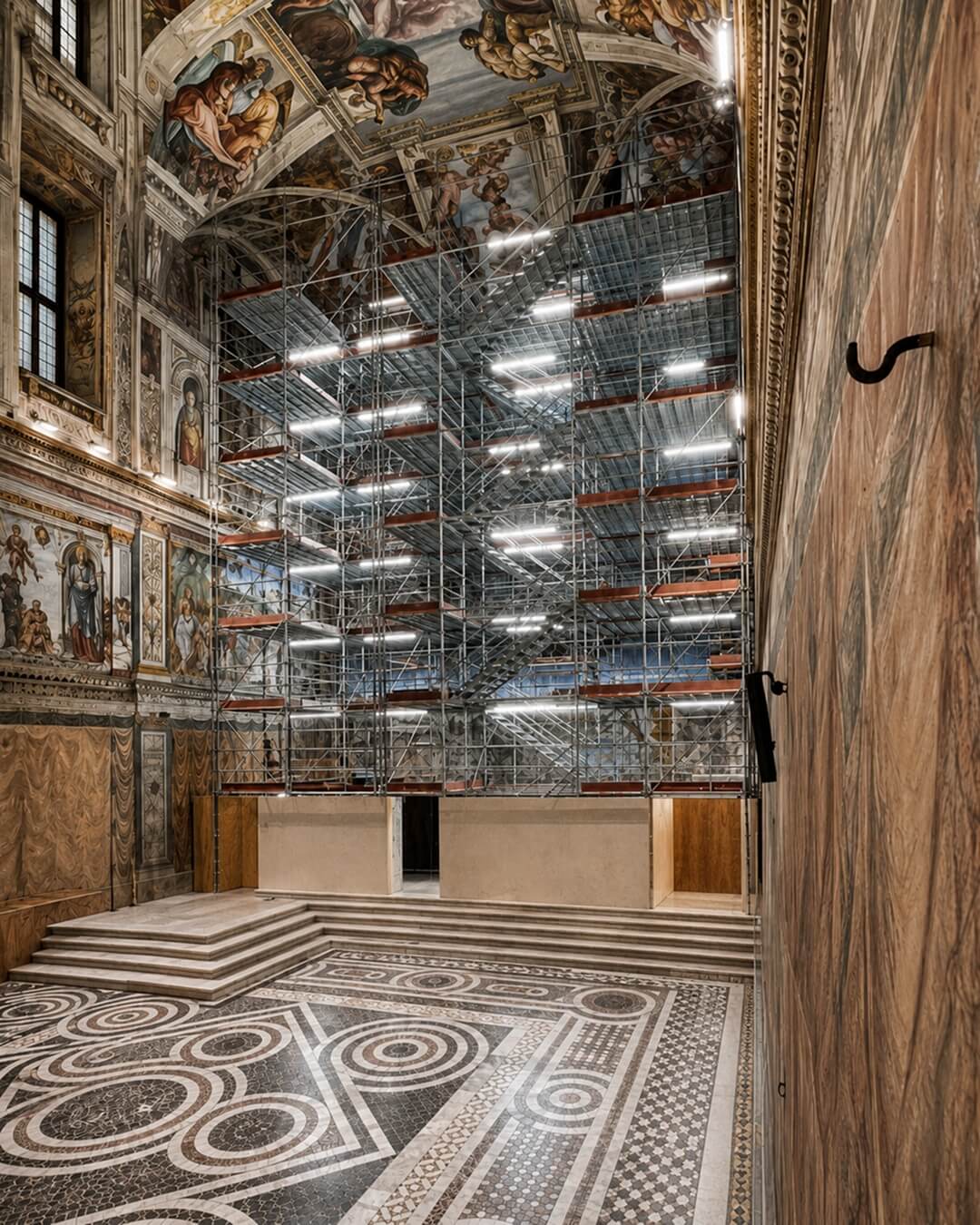
On 1 February 2026 scaffolding began to go up in the Sistine Chapel. By the end of March it had come down, and Michelangelo's Last Judgment looks different from the one seen by everybody between 1994 and this winter.
The Vatican Museums' own wording is pointedly modest: not a restoration but extraordinary maintenance. The distinction is not bureaucratic, and it repays a minute of attention.
What Was Taken Off the Fresco
Michelangelo painted the altar wall of the chapel between 1536 and 1541. The last serious intervention on it finished in 1994, under the general supervision of Carlo Pietrangeli and carried out by the chief restorer Gianluigi Colalucci. That campaign was called the restoration of the century: it gave the fresco back a colour that had been argued over beforehand, and rewrote the understanding of Michelangelo's palette.
In the thirty years since, the surface acquired a thin whitish veil, described as a light layer of salt deposits, invisible point by point but reducing the legibility of the fresco as a whole. That was what came off.
The work was done by the Vatican Museums' Laboratory for the Restoration of Paintings and Wooden Materials under Paolo Violini, together with the Scientific Research Cabinet, the Office of the Conservator and the Photographic Laboratory. It was funded by the Florida Chapter of the Patrons of the Arts in the Vatican Museums.
Barbara Jatta, the director of the museums, described the task without ceremony: lift a light patina and return Michelangelo's colours to their force. Work started on 2 February and finished after Easter.
Why It Was Not a Restoration
A restoration is an intervention in the painting. This was the removal of a layer that had settled on top of it.
The distinction matters for one reason. After 1994 the Vatican Museums did not sit and wait for the next crisis; they set up a preventive maintenance programme for the chapel's entire decorative scheme, based on constant monitoring of the surfaces and the periodic removal of accumulated deposits. The logic is that of looking after a building rather than rescuing a picture.
The reason for it is plain and unflattering. The chapel takes a flow of visitors on a scale no museum room matches, and the condition of the frescoes has to be assessed precisely in relation to that flow. The people who come to look are the principal agent of wear.
The Night Shift
The most interesting part of this story is the part no visitor ever sees.
Preventive maintenance in the Sistine is carried out exclusively at night, from mobile platforms. Over the years that work has progressively covered Michelangelo's lunettes, the series of papal portraits and the great fifteenth-century scenes along the side walls. By day the chapel takes thousands of people; by night it holds platforms, and it has done for decades.
Which is to say the fresco you look up at for twenty minutes is serviced rather as an aircraft is serviced: to a schedule, between flights, by an in-house crew.
What Colalucci Did
To see the point of the present cleaning you need to know what the previous one was.
Before the 1994 campaign Michelangelo was taken for a muted, almost monochrome painter who worked through shadow and volume rather than colour. The Colalucci restoration took centuries of candle soot and glue repainting off the ceiling and the altar wall, and found underneath a palette nobody had expected: sharp pinks, acid greens, oranges. It overturned the understanding of his painting and started an argument that ran for years, with some critics maintaining that the artist's own glazes had come off along with the dirt.
The present intervention is deliberately built the other way. It does not touch the painting itself and removes only what settled on top of it over thirty years. Hence the museums' cautious wording, and hence three months rather than nine years.
What It Looked Like From the Floor
The chapel did not close for a single day, and the visiting hours did not change.
The restorers worked behind an enormous cloth on which the image of the Last Judgment was reproduced in high definition. The scaffolding rose twenty metres and covered the whole wall. Six months ago, in other words, people coming into the chapel were looking at a photograph of the fresco where the fresco should have been, and most of them had no idea.
Every stage was recorded by the museums' Photographic Laboratory, so this cleaning will leave behind documentation of a kind no earlier intervention had.
Why It Could Not Be Closed
There is a reason the museums insisted so firmly that the chapel would stay open, and it is not about ticket revenue.
The Sistine Chapel is not a museum room but a working liturgical space and the place where a conclave is held. The last was in the spring of 2025, after the death of Francis: the cardinals gathered under this ceiling and elected Leo XIV. The world watched a live feed of a chimney on this roof.
A room in which popes are chosen cannot be taken out of service for three months to accommodate scaffolding. Hence the printed cloth, hence the night shifts, and hence the word maintenance rather than restoration. This is the upkeep of a working building, not a museum project.
What to Look at Now
The difference is not that the fresco is brighter. It is that it reads.
Look for depth. Michelangelo set the Last Judgment against an intense blue against which the figures are meant to separate and come forward. The whitish film worked directly against that: it lifted the overall tone, flattened the contrast and pressed the figures back into the plane. With the veil gone, the reason that blue was chosen comes back.
The second thing to look for is bodies. There are more than four hundred of them, and no two repeat. Find one figure in the lower third and follow it through, instead of sweeping your eye across the whole wall.
A third thing, on the way. The Hall of Constantine, painted by Giulio Romano to Raphael's design, reopened after its own restoration in 2025, and tour groups reliably walk past it because everyone is heading for the four Rooms. Those frescoes had been darkening for centuries and are now closer to their original palette than at any point in living memory. It is two steps off the route and nearly empty.
And one practicality. The Sistine remains the end point of the route through the Vatican Museums rather than a separate entrance, so the whole question of getting in is settled at the museum doors, not here. How that works is covered separately in the Vatican without the queue.
The whole city, on the map ItaGuide. Open City map of Rome.