The hardest Biennale in decades — and why to go all the same
The 61st Venice Biennale meant to be the quietest in a century. It turned out the opposite: the curator's death, the jury's resignation, pavilion protests. A curator's look, without illusions.
The Biennale 2026 meant to be quiet. Its motto, In Minor Keys, is an exhibition about a whisper, not a spectacle, about slow looking in place of queues for a story. It turned out exactly the opposite. It may be the loudest and most scandal-ridden Venice Biennale in years — and that is precisely why it is worth going.
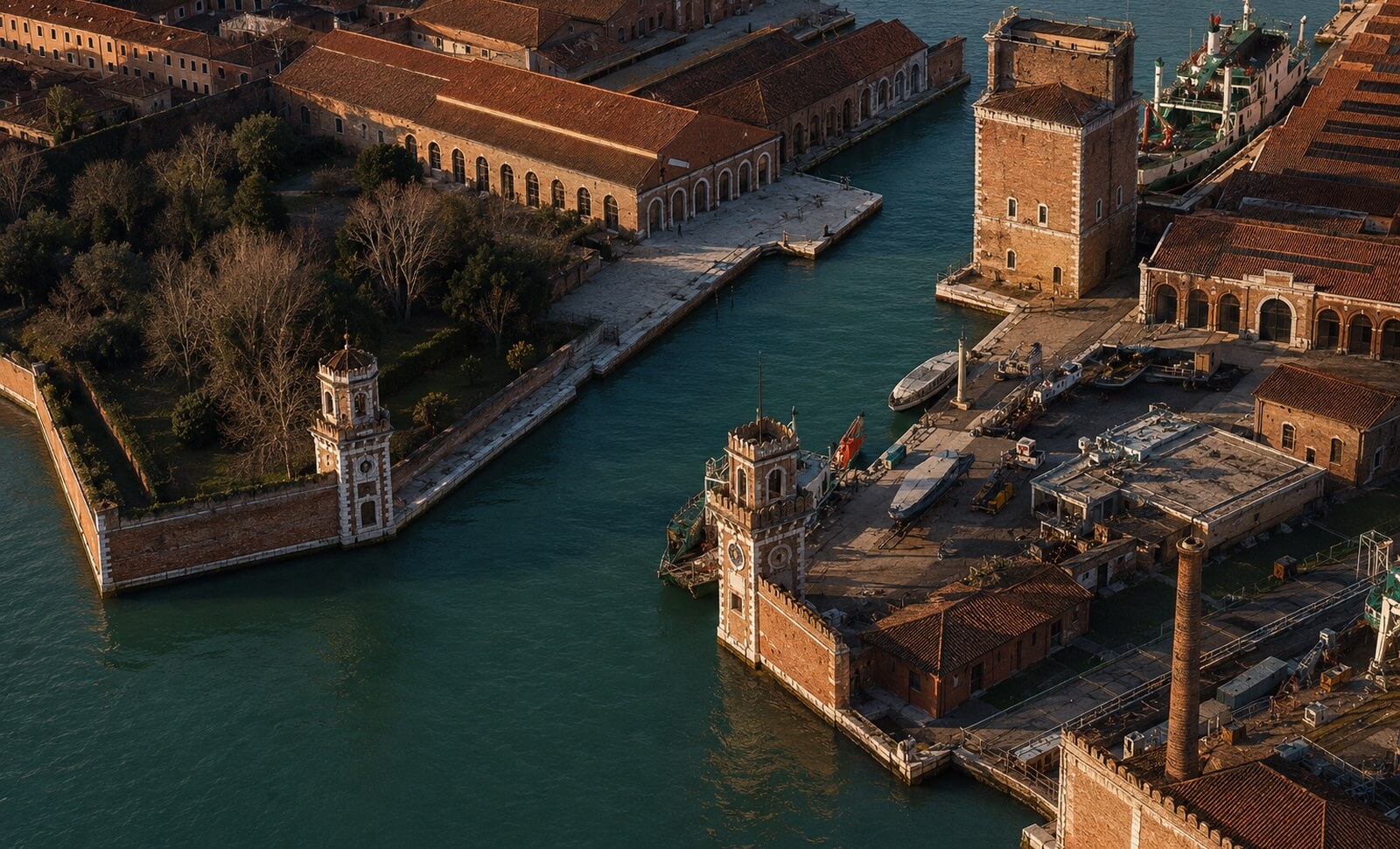
Let us look honestly at what happened and what is really worth seeing. The 61st Venice Biennale runs from 9 May to 22 November 2026 in the Giardini and the Arsenale.
The curator who did not live to see her exhibition
The idea of the Biennale 2026 was conceived by Koyo Kouoh — a curator of Cameroonian-Swiss background, director of the Zeitz MOCAA museum in Cape Town, a figure of world stature. She was appointed in December 2024. In May 2025, a year before the opening and only days after her diagnosis, she died suddenly.
The Biennale took a rare decision: to bring the exhibition through exactly as Kouoh had conceived it. The theme, the choice of artists, the architecture of the display she had managed to set — and her team of advisers realised the project quite literally to the late curator's drawings. And so Venice got a ghost Biennale: an exhibition about quiet frequencies, led by an absence.
The jury that refused to judge
Then, sharper still. On 30 April 2026 the Biennale's international jury resigned in full. In their statement the judges made it clear that they refused to consider countries whose leaders are accused by the International Criminal Court of crimes against humanity.
The Biennale was left without a jury. The award ceremony was moved from the opening to the last day — 22 November. And in place of the professionals' Golden Lions, this year the Public's Lions (Leoni dei Visitatori), gold and silver, will be given, voted for by the visitors themselves. For the first time in decades the prize is handed out by the public, not a curatorial areopagus.
The pavilions that closed
On 8 May, during the preview days, a number of national pavilions closed in protest — against Israel's participation amid the war in Gaza. Among those that closed were Austria, Japan, South Korea, France, Belgium, the Netherlands and Egypt.
And it is not the season's only drama. South Africa withdrew its video Elegy, dedicated to the victims in Gaza — the work was in the end moved to the Venetian church of Sant'Antonin. The United States long struggled to find an artist willing to represent the country; it shows Alma Allen, but two galleries left his representation. Australia first withdrew and then reinstated its artist Khaled Sabsabi after a public scandal. A Biennale conceived as a zone of quiet turned into a political field.
What, against this backdrop, is truly worth seeing
The paradox is that, artistically, the season is outstanding.
- Qatar has for the first time built a permanent pavilion in the Giardini — the first new building in the historic gardens in almost 30 years, since the Korean pavilion of 1995.
- The main exhibition, In Minor Keys, is laid out, as always, in the Giardini and the Arsenale — two venues ten minutes' walk apart.
But the strongest art of Venice 2026 is not only inside the Biennale but across the whole city, in the parallel exhibitions (to which we devote a separate guide). In brief, what not to miss: Marina Abramović at the Gallerie dell'Accademia, Anish Kapoor at Palazzo Manfrin, Lorna Simpson and Paulo Nazareth at the Punta della Dogana, Michael Armitage at Palazzo Grassi, Dale Chihuly at the Istituto Veneto, Lee Ufan at SMAC on St Mark's Square.
How to see it without losing your mind
The Biennale is enormous: more than a hundred artists in the main exhibition plus nearly a hundred national pavilions. In a day it is not to be 'walked through' — nor need it be.
- When: weekdays are better than weekends; in summer there are extended hours. Mondays closed (except 11 May and 16 November).
- Tickets: adult €20, student €15; take them online to avoid the queue at the desk.
- How: do not try to see everything. The motto In Minor Keys is also an instruction for viewing: go slowly, choose 6–8 pavilions and one or two parallel exhibitions, and let the rest go.
Herein lies the nerve of the Biennale 2026. An exhibition that asked for quiet got the loudest season in years — the curator's death, the jury's revolt, the pavilions' strike. But it is precisely this contradiction — between the minor key and the shouting world around it — that makes it essential. You are not going for a Golden Lion. You are going to see how art behaves when the world is shouting.