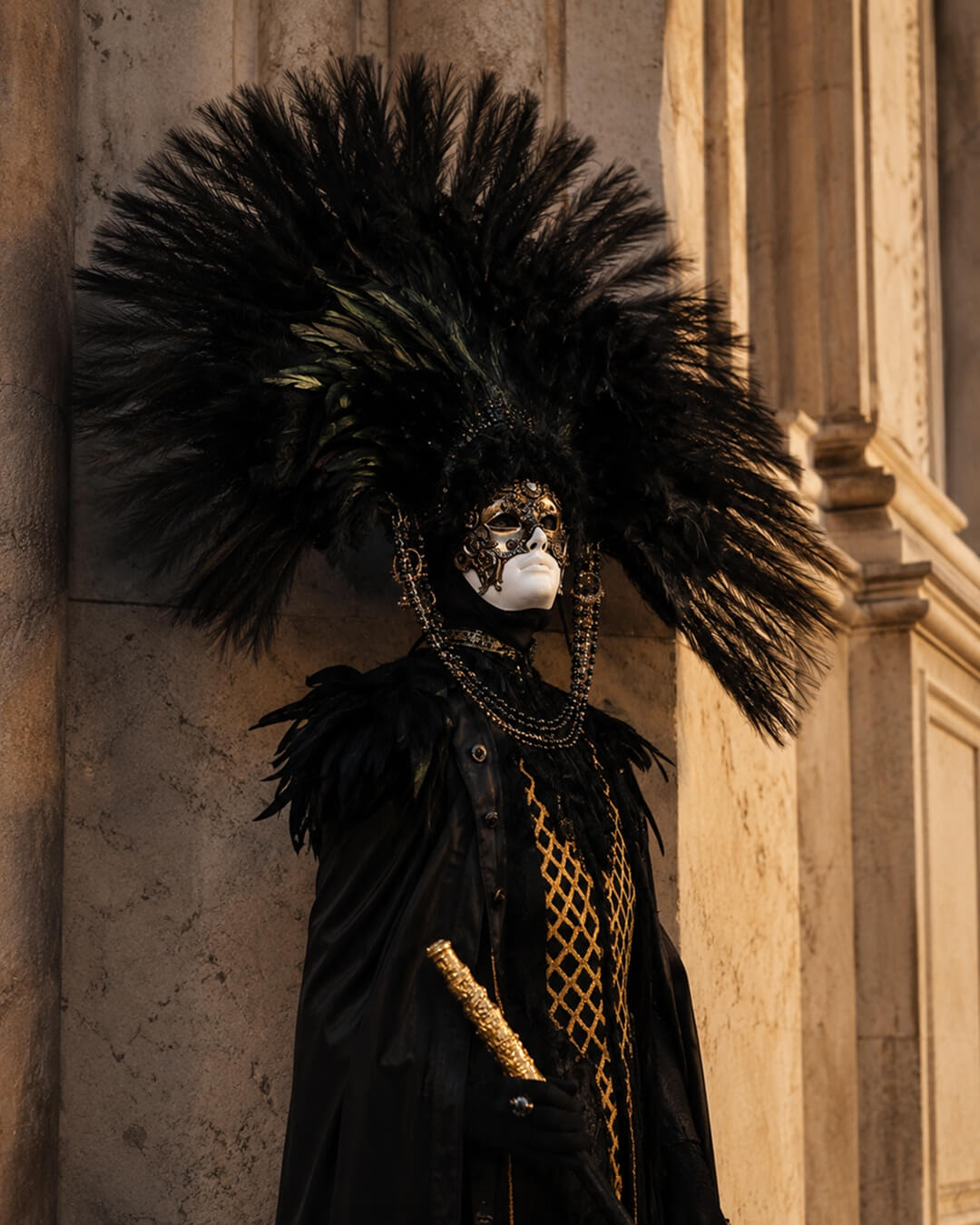
The Venice Carnival 2027: How to Get Into a Palazzo Ball
It runs from 23 January to 9 February, and the part that matters happens behind doors that stay shut the rest of the year
The Venice Carnival exists in two versions, and they barely overlap.
The first is St Mark's Square: a stage, a costume competition, a crowd holding phones, people in crinolines posing for money. The second happens behind the doors of palazzi that in an ordinary year nobody enters at all. Both are real, but people come for the first and talk afterwards about the second.
The 2027 Dates
The Carnival runs from 23 January to 9 February 2027. The ninth is Martedì Grasso, the last day, after which Lent begins immediately.
One caveat. Some calendars give 30 January as the start. Go by the Carnival's official site, which gives 23 January; the discrepancy comes from the programme building gradually, with the first week noticeably quieter than the second.
Why There Are No Floats
This is the first thing to understand about Venice if you have seen the carnivals at Viareggio or Putignano.
There the festival is built on a procession: giant papier-mâché figures, satire, a timetable of parades. Venice has none of that and geographically cannot: a float will not cross a bridge.
So the city itself becomes the spectacle. Costumes appear in the streets every day of the Carnival, thickest around San Marco but in groups out in the further campi too. On the stage in the square a competition for the best mask runs through the period, with its final on Martedì Grasso, and on that same last day the Maria of the Carnival is chosen, which closes the whole thing.
The First Weekend and the Last
The programme runs to two peaks with a trough between them.
The opening weekend rests on a water procession along the canals and on the Flight of the Angel, when a costumed figure descends on a cable from the San Marco campanile into the square. It is the most crowded event of the entire Carnival, and watching it from the square means standing in a crowd for an hour and a half in exchange for a minute.
The closing weekend is denser in substance: Giovedì Grasso, the Friday after, Sabato Grasso and the finale on Martedì Grasso with the last mask competition and the choosing of the Maria.
Between those two peaks come several days when the costumes are already on the streets and the visitors are not. That is the best time to come, and almost nobody uses it.
What It Was Historically
The festival appears in a doge's document as early as 1094. In 1269 the Venetian senate ruled that the day before Lent should count as a holiday, and from that point the Carnival becomes a civic institution rather than a spontaneous party.
Then came a long gap: French rule, then Austrian, and the Carnival in its old form disappeared for the better part of two centuries. It was brought back only in 1979.
Which means the Carnival you will see is older than the Venetian Republic in conception and younger than most people alive in execution. It is neither an antiquarian reconstruction nor an unbroken tradition but a deliberate revival, and Venetians are quite calm about saying so.
The Palazzo Balls
Here is what the people who come to Venice in February seriously are coming for.
Running alongside the street programme is a dense schedule of private events: masked balls, gala dinners with performance, parties with live music. The formats differ, but they share one thing: they take place in palaces closed for the rest of the year. Getting inside a Venetian palazzo, seeing its rooms and mirrors and chandeliers from within rather than from the water, is worth the ticket on its own even without a ball attached.
The schedule is not evenly spread. The density falls on Giovedì Grasso, the Friday after it, Sabato Grasso and the Saturday before that. Outside those days the choice narrows considerably.
The practical consequence is simple. Tickets to the better balls go months ahead, a costume takes arranging, and the dress code at the serious events is not decorative. If you intend to go to a ball, that is a November decision, not a January one.
If you want someone to match a ball to you, secure the tickets and settle the costume, that is a private ItaProfile service.
What to Allow For Besides the Programme
Three things that spoil the Carnival for anyone who has not planned around them.
High water. Late January and February are exactly tide season. In 2026 the laying of the raised walkways at key points was suspended for three weeks precisely because of the Carnival crowds, the walkways getting in the way of pedestrian flow. So in Carnival week the infrastructure you expect may not be where you expect it. How to read the tide forecast is covered separately in acqua alta and the MOSE.
Density. St Mark's on a Carnival weekend is the most tightly packed place in Italy. If the aim is to look at costumes, go on a weekday and go early: the same people in the same costumes come out daily, and the crowd around them is a fraction of the size.
Beds. Carnival dates are peak Venetian pricing, level with the Biennale and the film festival. A February hotel is booked in autumn.
And a fourth thing almost everyone forgets. Carnival dates are not fixed to a week of the calendar: they are tied to Easter and move every year, sometimes by a month. In 2027 the finale falls on 9 February; in other years it can land in early March. Planning for the same week as last time does not work here, and the date has to be checked afresh each season.
About the Access Fee
Everyone asks, and today the answer is incomplete.
In 2026 the city's access fee applied from 3 April to 26 July, meaning the Carnival fell entirely outside it. The 2027 calendar had not been approved by the giunta as this piece went out, and a decision is expected in late autumn.
The practical position: there is no need to budget for the fee on a Carnival trip yet, but it cannot be ruled out either, because Carnival weekends are precisely the peak flow the fee was designed for. How it works and what is known about 2027 is covered separately in the Venice access fee.
What to Eat
Carnival food in Venice comes down to two things, both sold everywhere for about three weeks a year.
Fritole are fried balls of yeasted dough, classically with raisins and citrus zest, in modern versions filled with custard or zabaglione. Galani, also called crostoli, are thin strips of dough fried until they shatter and buried in icing sugar. They are eaten standing up, out of a paper bag, which is the whole point.
After Martedì Grasso both vanish from the windows until the following year.
The whole city, on the map ItaGuide. Open City map of Venice.