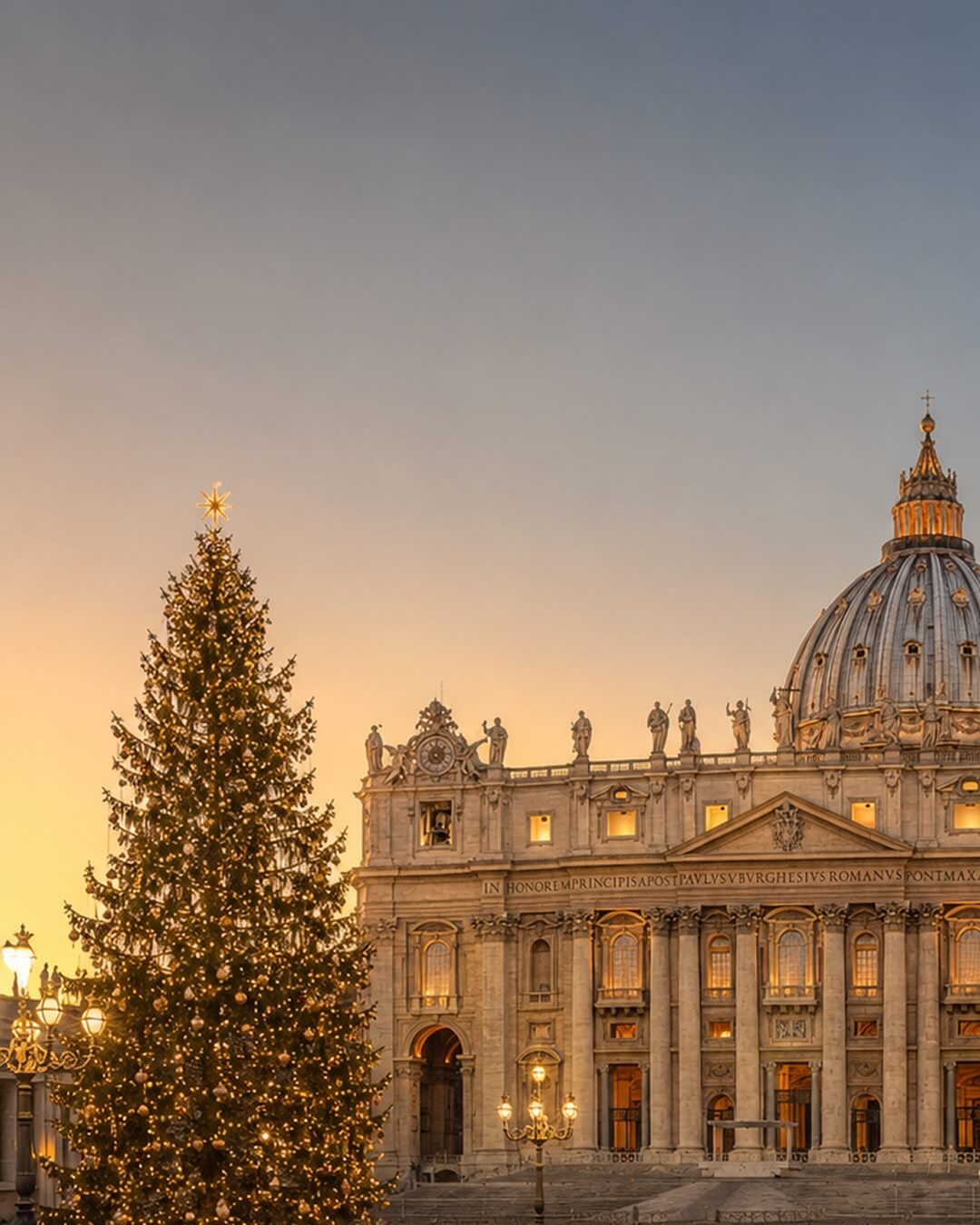
Rome From November to February: The Season Nobody Books
Winter Rome is sold as a consolation prize for bad dates, when on three counts it beats the high season outright
Winter Rome is usually sold as a compromise: cheaper, emptier, but the weather. The description is exactly half honest, and it is the other half that gets left out.
There are three things winter does better than the high season, and none of them is about saving money.
The Light
This is not an aesthete's quibble but physics, and it changes how the city looks.
In a Roman summer the sun sits high, the shadows are short, and travertine and tufa burn out into a white blank. The Forum at midday in July reads badly: the relief disappears, the columns merge with the background, the photographs come out flat.
In winter the sun stays low all day. The shadows are long, the grain of the stone comes forward, and the Forum and the Palatine acquire depth for the first time. The same goes for façades: baroque modelling is designed for raking light, and raking light is what December and January give it, not June.
The Queues
To the usual winter easing there is now a factor that was not there before.
The Jubilee ended on 6 January 2026. Across the year 33,475,369 pilgrims passed through the city, the Holy Doors are bricked up until 2033, and there is no structural reason to gather crowds on that scale for another seven years. There is more on that here.
The Vatican deserves saying separately, because the misconception is expensive. The Vatican Museums remain the most visited interior in Italy in any season, and a January queue without a ticket holds up as well as a July one. Winter takes the pressure off the city but not off the Vatican: a timed ticket is required regardless.
Artichokes, and the Truth About the Season
The Roman artichoke IGP is the round, spineless one that goes into carciofi alla romana and alla giudia. The central head is called the cimarolo or mammola; it can be more than ten centimetres across and weigh up to three hundred grams.
Now the part almost nobody states correctly. The harvest does begin in January, but not all of it: January brings the early Castellammare cultivar, while the late Campagnano is not ready until the beginning of March. Picking runs to May, and the optimal weeks are early March and the whole of April.
The honest conclusion follows. In January the artichoke is there and it is good, but its best version arrives six weeks after you have gone home. If a trip is being planned around food rather than around museums, February beats January and March beats February.
It is worth knowing the difference between the two preparations, because people order at random and these are two different dishes. Alla romana is done in a pan: trimmed, set head down and braised in oil with garlic, parsley and mentuccia, the local wild mint without which Romans will not accept the dish. The result is soft, almost creamy. Alla giudia is deep-fried whole until the outer leaves shatter like crisps while the heart stays tender. It is a dish of the Roman ghetto, and Trastevere does it less well than the Sant'Angelo quarter does.
Incidentally, the Roman artichoke was the first Italian product to win European IGP protection, in November 2002. In Lazio it grows in three areas: on the coast near Ladispoli and Cerveteri outside Rome, in the province of Viterbo and in the province of Latina.
January Does Not Run on Your Calendar
This is where a visitor's plan most often breaks.
The sixth of January, Epiphany, is a public holiday in Italy, and it matters more than it looks from outside: for many families it closes the Christmas cycle and ends the school holidays. The city moves slowly on those days, some small businesses are shut, and the ones that are open are full of Romans rather than visitors.
Two things follow. First: do not put anything in the first week of January that depends on a small shop, a workshop or a family trattoria being open without checking first. Second, more pleasantly: those are precisely the days when you can watch the city living for itself rather than serving a flow.
What to Do About the Weather
A Roman winter is mild by northern standards and wet by southern ones. Cold as such does not really happen; rain does, and it arrives in bands: two grey days, then three clear ones.
From which comes the single planning principle that saves the most frustration. Do not schedule winter Rome day by day in advance. Make two lists, outdoor and indoor, and allocate them each morning according to the sky. The Forum, the Palatine, the Appian Way, the villas and the viewpoints go in the first. The Vatican, the Capitoline Museums, Palazzo Massimo and the Scuderie go in the second.
And keep in reserve the option that works in any weather and that almost nobody thinks of: the Colosseo/Fori Imperiali station on Line C, with an excavation inside it. It is underground, it costs the price of a metro ticket and it is two steps from the Forum. Covered separately.
What Is New and Works Better in Winter
Three places that have changed in the last eighteen months, and all three are better cold.
Piazza Pia. The ground between Castel Sant'Angelo and the approach to the basilica was handed to pedestrians, making it the largest pedestrian area in the city. In summer there is no shade on it. In winter it is the best evening walk in Rome: a short day means the sunset catches you exactly halfway along.
The Colosseo/Fori Imperiali station. An excavation inside a working metro station, entry on an ordinary ticket, underground and warm.
The Last Judgment. In the spring of 2026 the Vatican Museums lifted the whitish film that had built up since 1994, so the fresco now reads differently from the way it has for thirty years. What was done and where to look is covered separately.
What Winter Is Actually Best For
Three things that work better then than in any other season.
The Forum and the Palatine at sunset. In winter the sun sets early, and it is the only time of year when the golden hour falls inside opening times rather than after closing.
The Appian Way. In summer there is no air on it and nowhere to hide. In winter it is the best walk in Rome, and on Sundays, when it is closed to traffic, it belongs to people on foot.
Churches. Rome has hundreds of them, almost all free to enter, warm inside and nearly empty. In winter they stop being items on a list and become what they were designed to be: places you step into on the way past.
One last thing to check before the trip rather than on the spot. The major archaeological sites run a reduced winter timetable: from November to February they close noticeably earlier than in summer, and last admission can be an hour before that. The exact hours change from season to season, so check the official site the day before rather than trusting last year's memory. This is what most often wrecks the plan to reach the Forum at sunset.
The whole city, on the map ItaGuide. Open City map of Rome.